
An advanced, minimally invasive method of repairing hernias is robotic hernia surgery. An advanced, minimally invasive method of repairing hernias is robotic hernia surgery. A robotic surgical system is used by a highly skilled surgeon to carry out the procedure with improved control and precision. A robotic surgical system is used by a highly skilled surgeon to carry out the procedure with improved control and precision. Compared to open or standard laparoscopic surgery, this method has several advantages, such as better visualization, more flexibility, and increased accuracy. Compared to open or standard laparoscopic surgery, this method has several advantages, such as better visualization, more flexibility, and increased accuracy. It works particularly well for complex, recurrent, or bilateral hernias. It works particularly well for complex, recurrent, or bilateral hernias. This approach helps patients recover more quickly and experience less discomfort following surgery. This approach helps patients recover more quickly and experience less discomfort following surgery.
When an internal organ or tissue pushes through a weak spot in the muscle or connective tissue wall, it results in a hernia. When an internal organ or tissue pushes through a weak spot in the muscle or connective tissue wall, it results in a hernia. Inguinal, umbilical, incisional, femoral, and hiatal hernias are examples of common hernias. Inguinal, umbilical, incisional, femoral, and hiatal hernias are examples of common hernias. Hernias can grow and cause problems like obstruction or strangulation if they are not treated. Hernias can grow and cause problems like obstruction or strangulation if they are not treated.
Depending on the hernia's size and type, symptoms can include:
Visible Bulge: An obvious enlargement in the abdomen, groin, or site of prior surgery
Pain or discomfort: Particularly when coughing, bending, lifting, or standing for extended periods of time
Heaviness or Pressure: A feeling of pressure or dragging in the afflicted area
Sensation of Burning or Aching: Pain in the area surrounding the bulge
Vomiting or nausea: In extreme situations, this may indicate a problem like bowel obstruction
Increased abdominal pressure and muscle weakness combine to cause hernias. Among the contributing elements are:
Prolonged constipation or straining
Chronic coughing
Abrupt weight gain or obesity
Strenuous physical activity or heavy lifting
Cigarette use
Inadequate nourishment
Prior abdominal surgeries
buildup of fluid in the abdomen
Abdominal wall weakness that is congenital
Robotic surgery is useful for:
Hernia Inguinal
Inguinal Hernia on Both Sides
Hernia in the Femur
An umbilical hernia
Hernia Incisional
Repeated Hernia
Large or Complicated Hernias
Hernias are diagnosed through:
Physical Examination: Finding a weakness or bulge
Imaging tests: MRI, CT scan, or ultrasound for surgical planning and confirmation
Review of medical history, including risk factors and previous surgeries
Watchful Waiting: Under medical supervision for minor, painless hernias
Dietary adjustments, weight management, and avoiding heavy lifting are examples of lifestyle modifications.
The only effective treatment for hernias is surgery.
Repairing an Open Hernia (Herniorrhaphy)
Repairing a Laparoscopic Hernia
Robotic Hernia Repair: A cutting-edge, minimally invasive method with better results
Improved high-definition 3D visualization
Increased control and accuracy during surgery
Very little blood loss
Less scarring and smaller incisions
Less postoperative pain
Shorter hospital stays and quicker recovery
Reduced chance of recurrence in specific situations
Preoperative Tests: ECG, imaging, blood tests, and anesthesia assessment
Medication: Pay attention to the surgeon's advice regarding continuing medication.
Steer clear of alcohol and tobacco for a few days before surgery.
Fasting: Unless instructed otherwise, avoid eating or drinking anything after midnight prior to surgery.
Observation: Following surgery, the patient is observed and moved to a room.
Diet: On the same day, liquids were permitted; the regular diet was gradually resumed.
Mobility: On the same day, early walking is recommended.
Discharge: Depending on recovery, usually the same day or the following day
Wound Care: Usually after five days, dressings are reviewed during follow-up.
Medication: Antibiotics and painkillers as directed
Compared to traditional surgery, the majority of patients recover in 1-2 weeks. While heavy lifting should be avoided for a few weeks as recommended by the surgeon, regular daily activities can be resumed early.
Keep your weight in check.
Consume a diet high in fiber to avoid constipation.
Refrain from smoking
When lifting heavy objects, use the right techniques.
Develop your core muscles under expert supervision.
Our skilled surgical team at Yatharth Hospital provides safe, accurate, and patient-centered hernia care by fusing cutting-edge robotic technology with evidence-based clinical knowledge. We guarantee all-encompassing care under one roof, from precise diagnosis to full recovery following surgery
India’s leading specialists.
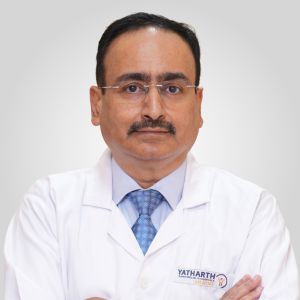
MBBS, MS (General Surgery)
General & Laparoscopic Surgery
Robotic Surgery

MBBS, MS (General Surgery)
General & Laparoscopic Surgery
Robotic Surgery

MBBS, MS (General Surgery), FNB - Minimal Access Surgery
General & Laparoscopic Surgery

MBBS, MS, MMAS (Mastery in Minimal Access Surgery)
General & Laparoscopic Surgery

MBBS, DNB, FIAGES, FALS-Bariatric Surgery, FNB- Minimal Access Surgery
General & Laparoscopic Surgery

MBBS, MS (Surgery)
General & Laparoscopic Surgery
Robotic Surgery

MBBS, MS, FAIGES, FALS
General & Laparoscopic Surgery
Robotic Surgery

MBBS, MS (General Surgery)
General & Laparoscopic Surgery

MBBS, MS (Gen. Surgery)
General & Laparoscopic Surgery

MS, FNB, FALS (Bariatric Surgery), FCRS (Hongkong)
General & Laparoscopic Surgery
Becoming a mother again at 40 was emotional, but I felt completely safe in the hands of Dr. Sonal Bathla. Nancy Chadha shares her...

Becoming a mother again at 40 was emotional, but I felt completely safe in the h...

This video highlights the successful outcome of a Complex Total Knee Replacement...

Meet Mr. Satish Chand Chawla, who underwent HOLEP – Holmium Laser Enucleation ...
Meet Mrs. Nirmala Singh, who underwent a Successful Vaginal Hysterectomy Prolaps...

Mr. Sanjay Kaushik’s journey is a powerful story of hope and recovery after ba...
This blog will explore common surgical procedures, discuss how to prepare for surgery, delve into the surgical process, ...

Hernias are common medical conditions that affect millions of people worldwide. Despite their prevalence, many individua...
Laparoscopic or “keyhole” surgery is transforming patient care by reducing recovery time, minimizing risks, and impr...


